
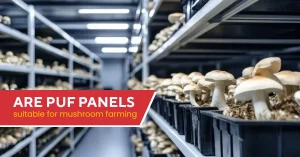
PUF panels are highly suitable for mushroom farming because they help create a controlled, hygienic, and energy-efficient growing environment. Mushroom cultivation depends heavily on precise temperature, humidity, and cleanliness, and PUF panels for mushroom farming make it easier to maintain these conditions consistently throughout the year.
As commercial mushroom farming grows rapidly in India, farmers are moving away from traditional brick or shed structures and adopting modern insulated solutions. Among these, PUF (Polyurethane Foam) panels have emerged as one of the most practical and reliable construction materials for mushroom growing chambers.
This blog explores why PUF panels are suitable for mushroom farming, how they work, and what to consider when designing and maintaining a PUF-based mushroom unit.
Understanding PUF Panels
PUF panels, also known as insulated sandwich panels, consist of a rigid polyurethane foam core placed between two protective sheets, usually pre-painted galvanised iron (PPGI) or aluminium. The foam core acts as a powerful thermal insulator, while the outer layers provide strength, durability, and resistance to moisture.
In mushroom farming, environmental control is critical. Different varieties, such as button, oyster, and milky mushrooms, require specific temperature and humidity ranges. PUF panels for mushroom farming help maintain these conditions by reducing heat transfer between the inside chamber and the external environment.
Another key benefit of PUF panels is their airtight structure. This minimises temperature fluctuations and prevents unwanted air leakage, which can otherwise disrupt mushroom growth cycles. Because of their modular design, PUF panels are easy to assemble, dismantle, and expand, making them suitable for both small-scale growers and large commercial farms.
Advantages of Mushroom Farming Using PUF Panel
Using PUF panels for mushroom farming offers multiple advantages that directly impact yield, quality, and operational efficiency.
Excellent Temperature Control
Mushrooms are highly sensitive to temperature changes. PUF panels provide superior insulation, helping maintain stable internal temperatures even during extreme summers or winters. This consistency leads to uniform mushroom growth and reduced crop losses.
Better Humidity Retention
Humidity plays a vital role in mushroom pinning and fruiting. PUF panels help retain moisture inside the growing chamber, reducing the need for excessive humidification and lowering energy consumption.
Energy Efficiency and Cost Savings
By reducing heat gain and loss, PUF panels significantly cut down electricity usage for cooling and heating systems. Over time, this translates into lower operational costs, making mushroom farming more profitable.
Hygienic and Contamination-Resistant
Mushrooms are prone to contamination from moulds and bacteria. The smooth, non-porous surfaces of PUF panels are easy to clean and disinfect, helping maintain a sterile growing environment.
Faster Construction and Scalability
Compared to conventional brick structures, PUF panel mushroom chambers can be installed quickly. This allows farmers to start production sooner and scale operations easily as demand grows.
Design Considerations for Mushroom Growing Chambers
While PUF panels provide an excellent foundation, the proper design of the mushroom growing chamber is equally important to achieve optimal results.
Chamber Layout and Size
The layout should allow easy movement for workers and efficient placement of racks or beds. Adequate spacing ensures proper air circulation and uniform growth across all shelves.
Ventilation and Fresh Air Exchange
Mushrooms require fresh air to release carbon dioxide produced during growth. Designing controlled ventilation systems along with PUF panels helps maintain the right balance without disturbing temperature and humidity.
Lighting Requirements
Most mushrooms do not need direct sunlight, but low-intensity lighting is required for certain stages of growth and for operational visibility. The chamber design should include moisture-resistant lighting fixtures.
Flooring and Drainage
A well-designed floor with proper drainage prevents water stagnation and reduces the risk of contamination. Anti-skid, washable flooring materials work best with PUF panel chambers.
Integration with Climate Control Systems
PUF panels for mushroom farming perform best when combined with humidifiers, exhaust fans, and cooling units. The design should allow easy installation and maintenance of these systems.
Maintenance and Care of PUF Panel for Mushroom Growing Chambers
Proper maintenance ensures long service life and consistent performance of PUF panels in mushroom farming units.
Regular Cleaning and Sanitisation
Panels should be cleaned and disinfected between crop cycles to prevent disease buildup. Their smooth surfaces make cleaning simple and effective.
Inspection for Damage or Gaps
Periodic inspection helps identify cracks, joint gaps, or surface damage that could affect insulation or hygiene. Prompt repairs maintain chamber efficiency.
Moisture Management
Although PUF panels are moisture-resistant, excessive water exposure over time should be avoided. Proper humidity control and drainage systems protect the panels.
Pest Prevention
Sealed PUF panel structures reduce pest entry, but routine checks ensure that insects or rodents do not find entry points around doors or vents.
Long-Term Durability
With correct care, PUF panels can last for many years without losing insulation efficiency, making them a long-term investment for mushroom farmers.
Cost and Return on Investment in PUF Panel Mushroom Farming
Initial construction using PUF panels may seem costlier than traditional methods, but the long-term benefits outweigh the upfront expense.
PUF panels for mushroom farming reduce energy costs, minimise crop losses, and improve yield quality. Faster construction also means quicker returns on investment. For commercial growers, these advantages translate into predictable production cycles and better market competitiveness.
Additionally, modular PUF panel systems allow future expansion without major structural changes, making them ideal for farmers planning gradual growth.
Suitability of PUF Panels for Different Mushroom Varieties
PUF panels are versatile and suitable for cultivating a wide range of mushrooms.
Button mushrooms require low temperatures and strict hygiene, both of which are easily achieved with insulated PUF chambers. Oyster mushrooms thrive in moderate temperatures and high humidity, conditions that PUF panels help maintain effortlessly. Milky mushrooms, which are popular in India, also benefit from controlled environments provided by PUF panel structures.
This flexibility makes PUF panels for mushroom farming a preferred choice across different cultivation methods and scales.
What Is the Mushroom Cultivation Cost in India?
If you are planning to start mushroom farming, understanding the mushroom cultivation cost in India is essential. The total investment depends on factors such as mushroom type, farm size, infrastructure, and climate control requirements. While small farms can begin with a lower budget, commercial setups require higher investment. Read the full guide to understand the complete cost breakdown before starting your mushroom farm.
Conclusion
PUF panels are undoubtedly suitable for mushroom farming, especially for growers aiming for consistent quality, higher yields, and long-term efficiency. Their superior insulation, hygienic surfaces, and energy-saving properties make them ideal for creating controlled mushroom growing chambers in India’s diverse climate conditions.
As mushroom farming continues to modernise, investing in PUF panel-based infrastructure can provide a strong foundation for sustainable and profitable cultivation.
If you are planning to set up or upgrade your mushroom farming unit, working with an experienced solution provider like Arasfirma can help you design and install reliable PUF panel systems tailored to your specific farming needs.